
☰
Walking and distance guides
How Far Is a 10K? Distance in Miles Explained
A 10K is 10 kilometres, approximately 6.2137 miles. Compare race distances, track laps and walking times, and distinguish a 10K from 10,000 steps.
How many miles is a 10K?
A 10K is 10 kilometres, equal to approximately 6.2137 miles. For everyday planning, 6.2 miles is a useful rounded description. The letter K in race names is shorthand for kilometres, so a 10K describes a distance rather than a finishing time or a step goal.
The conversion uses an international mile of exactly 1.609344 km, as listed by NIST. Divide 10 by 1.609344 to obtain 6.2137119… miles. The kilometre distance is exact; the shortened mile value is rounded.
If an event is advertised as a 10K run or walk, its stated distance is ten kilometres whether you complete it quickly or slowly. Check the organizer’s course information when the event is a trail outing, a fun run or an informal challenge: the name alone does not describe the surface, elevation or how the route was measured.
Compare 5K, 10K, half marathon and marathon distances
These are standard distances, with miles calculated from the exact kilometre values and rounded to four decimal places. The half marathon is half of 42.195 km. Popular labels such as 13.1 and 26.2 miles are convenient approximations rather than exact definitions.
| Event | Kilometres | Miles |
|---|---|---|
| 5K | 5 | 3.1069 |
| 10K | 10 | 6.2137 |
| Half marathon | 21.0975 | 13.1094 |
| Marathon | 42.195 | 26.2188 |
A 10K is exactly twice a 5K. Two 10Ks total 20 km, which is still 1.0975 km short of a half marathon. A marathon is 4.2195 times a 10K, rather than exactly four times the distance. This helps explain why a route made by joining four 10K loops is not marathon length.
World Athletics gives the marathon distance as 42.195 km. These comparisons describe distance only. Doubling an event’s distance does not establish that a person can maintain their shorter-race pace or that finishing time will simply double.
A 10K race is different from 10,000 steps
The number 10,000 appears in both phrases, but the units are different. A 10K race contains 10,000 metres. A 10,000-step goal contains 10,000 footfalls. Metres measure length; steps count actions whose length varies.
If each step advances 75 cm, 10,000 steps cover 7,500 metres, or 7.5 km. At that same hypothetical step length, covering a full 10K takes about 13,333 steps. If your step length is 1 metre, 10,000 steps would cover 10 km, but that equality comes from the chosen length, not from the meaning of 10K.
For distance from your actual step count, use the Steps to Miles Calculator. For a race-length footfall estimate, use Steps in a 5K, 10K, Half Marathon and Marathon. Its measured step-length input keeps the conversion personal without redefining the race distance.
The separate 10,000-steps distance guide explains the step-count question in more detail. It should not be used as a substitute for the fixed ten-kilometre definition.
Ways to picture a 10K distance
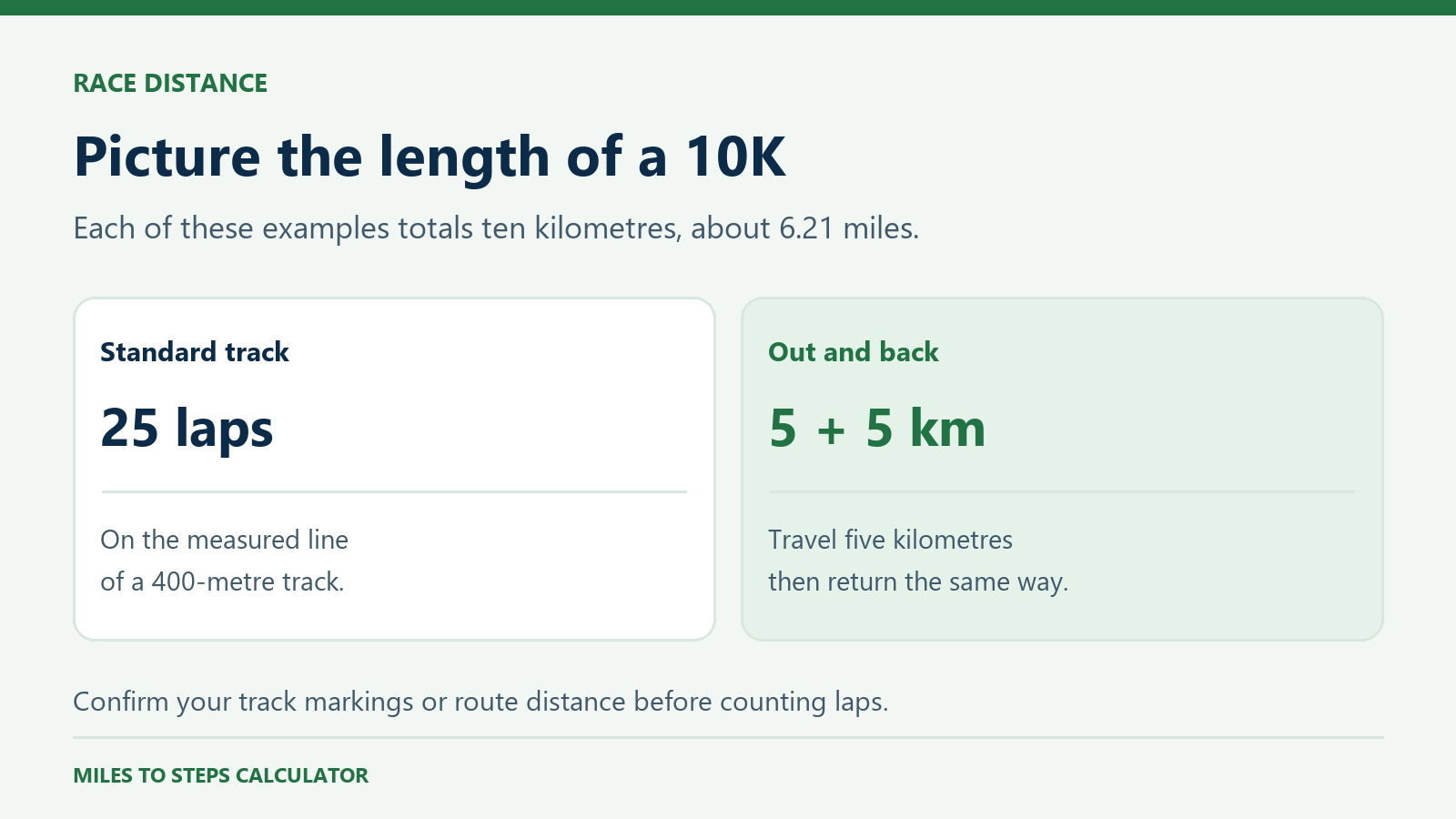
A standard 400-metre track
Ten thousand metres equals 25 laps of a standard 400-metre track when following its measured 400-metre running line. World Athletics describes the 10,000-metre track event as 25 circuits. Running a complete circuit in an outer lane covers more than 400 metres unless the start and measurement arrangement account for it.
Not every school track is 400 metres. Some are shorter, some use yards, and some facilities have nonstandard layouts. Confirm the posted track length before using 25 laps as your route.
An out-and-back route
Travel 5 km from the start and return along the same route for a total of 10 km. The turnaround is about 3.1069 miles from the start. A common planning error is to choose a point 10 km away and forget that returning makes the outing 20 km.
Repeated local loops
Five measured 2 km loops or ten measured 1 km loops also total 10 km. If a loop is only approximately a kilometre, its error repeats every lap. A route described as ten neighbourhood blocks is not a dependable conversion because block sizes differ greatly.
Is 6.2 miles exactly a 10K?
No. Multiplying 6.2 miles by 1.609344 gives 9.9779328 km. That is about 22.1 metres short of ten kilometres. For casual discussion the difference is small, but a measured race distance should not be defined by rounding its mile equivalent first.
The same issue appears if you round each kilometre to 0.62 mile, then multiply by ten. Keep the full conversion factor through the calculation and round the final displayed result. A route planner’s rounded label can be useful for orientation without being a precise course measurement.
A watch showing a distance slightly different from 10.00 km does not by itself prove that a course is long or short. The recorded path, signal and the line you follow can differ from the measured course line. The USATF course-certification resources explain the distinction between a measured road course and an informal distance reading.
How long does it take to walk a 10K?
Distance alone cannot determine finishing time. As simple constant-speed examples, a 10K at 3 mph takes about 2 hours 4 minutes of moving time; at 4 mph it takes about 1 hour 33 minutes. At 2.5 mph it takes about 2 hours 29 minutes. Stops add to those totals.
These examples are not race cutoffs or recommendations about a suitable pace. Check event rules and use a speed you can sustain over the whole route. Read the walking-time guide and distance chart for a fuller explanation of moving versus elapsed time, then use the Walking Time Calculator for your own scenario.
For running, the same distance-time arithmetic applies, but your selected pace changes the result. A 6:00 per kilometre pace gives a 60-minute 10K; 5:00 per kilometre gives 50 minutes. These are examples of the relationship, not predictions of a runner’s performance.
Read a route or event description accurately
- Check whether the distance is for the full route or one direction.
- Check kilometres versus miles, especially when an app changes its unit setting.
- Distinguish a road 10K from a track 10,000 m event, even though the total length is the same.
- Read elevation and surface information separately; ten kilometres does not describe difficulty.
- Use the organizer’s published timing and access rules rather than inferring them from the distance.
The most useful mental picture combines a known length with route context. A flat paved 10K, a hilly trail 10K and 25 track laps share the same nominal distance, but they do not necessarily share completion time or effort. Keep those questions separate when choosing a calculator or guide.
10K conversion questions
What does 10km to miles equal?
Approximately 6.2137 miles. Divide ten kilometres by 1.609344 kilometres per international mile.
Is a 10K longer than five miles?
Yes. Five miles is 8.04672 km, so a 10K is about 1.2137 miles longer.
Is a 10K a half marathon?
No. A half marathon is 21.0975 km, or about 13.1094 miles. A 10K is less than half that distance.
Can a 10K be walked?
The distance can be covered on foot at a walking pace, but whether a particular event accepts walkers and whether you can meet its cutoff depend on the organizer’s rules and your circumstances.
Sources and calculation notes
NIST supports the unit factor; World Athletics supports the marathon and track-distance definitions linked above. USATF provides the course-measurement context. All numerical examples here are calculated rather than measured participant results. Published November 7, 2026 by Miles to Steps Calculator. Methodology · Corrections.