
☰
Walking and distance guides
How Many Calories Does Hiking Burn? Weight, Terrain and Backpack Load Explained
Explore hiking calorie examples by body weight, duration and route length. Understand terrain, backpack categories and active versus total calories.
How many calories does hiking burn?
Hiking calorie expenditure depends on body weight, moving time and the type of terrain and load. A distance by itself cannot provide one reliable answer. A short, steep climb can require a different effort and duration from an equally long level path.
As a worked example, a 70 kg person hiking for one hour at a selected intensity of 5.3 MET has an estimate of 390 total kcal or 316 active kcal. The same equation at 6.0 MET gives 441 total kcal per hour. These are activity-model estimates, not measurements of an individual hiker.
Use the Hiking Calories Calculator to adjust body weight, moving minutes and the activity category. Keep the conditions visible when comparing results. Here, calories means dietary kilocalories (kcal); active and total calories are different quantities.
Hiking calories by body weight and duration
The following table uses 5.3 MET throughout, corresponding to a normal-pace, unloaded hike through fields and hillsides in the 2024 Adult Compendium. Moving duration excludes lunch, transport and lengthy stationary breaks. Two- and three-hour totals assume the same activity for that whole moving period.
| Body weight | 1 hr total | 1 hr active | 2 hr total | 3 hr total |
|---|---|---|---|---|
| 55 kg / ~121 lb | 306 | 248 | 612 | 918 |
| 70 kg / ~154 lb | 390 | 316 | 779 | 1,169 |
| 85 kg / ~187 lb | 473 | 384 | 946 | 1,419 |
| 100 kg / ~220 lb | 557 | 452 | 1,113 | 1,670 |
The larger figures at higher weights come from the equation’s weight term. A longer duration increases the result proportionally only when the selected intensity is unchanged. In practice, a long route can contain a mix of easy sections, climbs, descents and rests.
The table is useful for understanding the scale of the calculation. It is not a food prescription, a measured calorie deficit or a statement that every hike at a “normal” pace has the same cost. The kilogram-to-pound equivalents are rounded for convenience.
The MET method and its assumptions
Total kcal = MET × 3.5 × body weight in kg ÷ 200 × moving minutes. To calculate active kcal using this convention, replace MET with MET − 1. For 70 kg and 60 minutes at 5.3 MET: 5.3 × 3.5 × 70 ÷ 200 × 60 = 389.55 total kcal, rounded to 390.
A MET is a standardized way to express activity intensity. The Compendium’s definitions explain that standard, while its individual-variation notes explain why a standard MET is not a direct measurement of your personal energy expenditure.
These calculations use an adult activity framework. Fitness, movement economy and individual resting metabolism are not fully captured by multiplying one category value by weight and time. The calculator’s sensitivity band illustrates uncertainty in a scenario; it is not a validated confidence interval for a particular hiker.
Choose an activity category that resembles the hike
The calculator offers activity descriptions rather than pretending that a single calories-per-mile figure fits every route. The following values come from the Compendium’s walking and hiking categories:
| Scenario (paraphrased) | Code | MET |
|---|---|---|
| Slow unloaded hiking | 17081 | 3.8 |
| Unloaded walking through fields and hillsides | 17082 | 5.3 |
| Cross-country hiking | 17080 | 6.0 |
| Backpacking | 17010 | 7.0 |
| Organized daypack hiking | 17012 | 7.8 |
Choose the description that best matches what you actually did. Do not automatically choose the highest category because a route felt difficult. A slow pace on rough terrain can feel demanding without resembling the activity represented by a different category.
If a two-hour outing contains one hour resembling the 3.8 MET example and one resembling the 6.0 MET example, estimate the segments separately and add the calorie totals. Using a high-intensity category for the full two hours would overstate the assumption. The activity labels are broad approximations, so the result still needs to be interpreted cautiously.
How elevation, terrain and moving speed affect the estimate
Elevation gain and grade
Climbing increases the work of moving uphill, but total elevation gain and local grade are not interchangeable. A route gaining 500 metres gradually over a long distance differs from one gaining it over a short, steep section. Grade is rise divided by horizontal run, multiplied by 100; 100 metres of rise over 1,000 metres horizontally is a 10% grade.
Do not use the elevation difference between start and finish as the whole route’s climb. A loop can finish at its starting elevation after several substantial ascents. Record cumulative ascent when describing the route, and avoid turning that one figure into an unsupported calorie multiplier.
Surface and technical difficulty
Loose ground, uneven footing, mud and obstacles can change both your effort and your speed. A distance-only equation misses that context. Descending is also not simply “free” distance: the route can still require time and controlled movement even though the uphill workload has ended.
Duration
Longer moving time is a major reason a hike’s estimated total grows. Keep your stops separate. If you select a hiking category for three hours when only two hours were spent hiking, the equation is being given an extra hour of that activity.
Why hiking calories per mile vary so much
A per-mile value combines energy per minute with the minutes needed to cover a mile. Both can change. A steep mile may have a higher intensity and take longer than a level mile. A route with easier footing may be quicker at a similar perceived effort.
For illustration only, keep weight at 70 kg and intensity fixed at 5.3 MET. At 2 mph, one mile takes 30 minutes and the model gives about 195 total kcal per mile. At 2.5 mph it takes 24 minutes and gives about 156. This comparison holds intensity fixed to show the effect of time; it does not establish that walking faster always reduces real energy per mile. In a real comparison, the appropriate MET value can change too.
Do not reuse a per-mile estimate from a gentle trail for a steep backpacking route without revisiting its assumptions. Recording moving time and the activity description usually makes the result more interpretable than applying a single calorie number to every mile.
Examples for two-, five-, eight- and ten-mile hikes
These length examples assume 70 kg, 2 mph moving speed and 5.3 MET throughout. They are a consistent mathematical scenario, not average completion times for all trails. Stops are excluded, and no extra backpack multiplier is applied.
| Distance | Moving time | Total kcal | Active kcal |
|---|---|---|---|
| 2 miles | 1 hr | 390 | 316 |
| 5 miles | 2 hr 30 min | 974 | 790 |
| 8 miles | 4 hr | 1,558 | 1,264 |
| 10 miles | 5 hr | 1,948 | 1,580 |
Under those assumptions a five-mile hike takes 2 hours 30 minutes of movement, producing about 974 total kcal or 790 active kcal. If the actual moving time, weight or activity category differs, so will the estimate. A ten-mile hike is not automatically five times the practical demand of a familiar two-mile outing, even though the fixed-input model scales that way.
Does hiking burn more calories than walking?
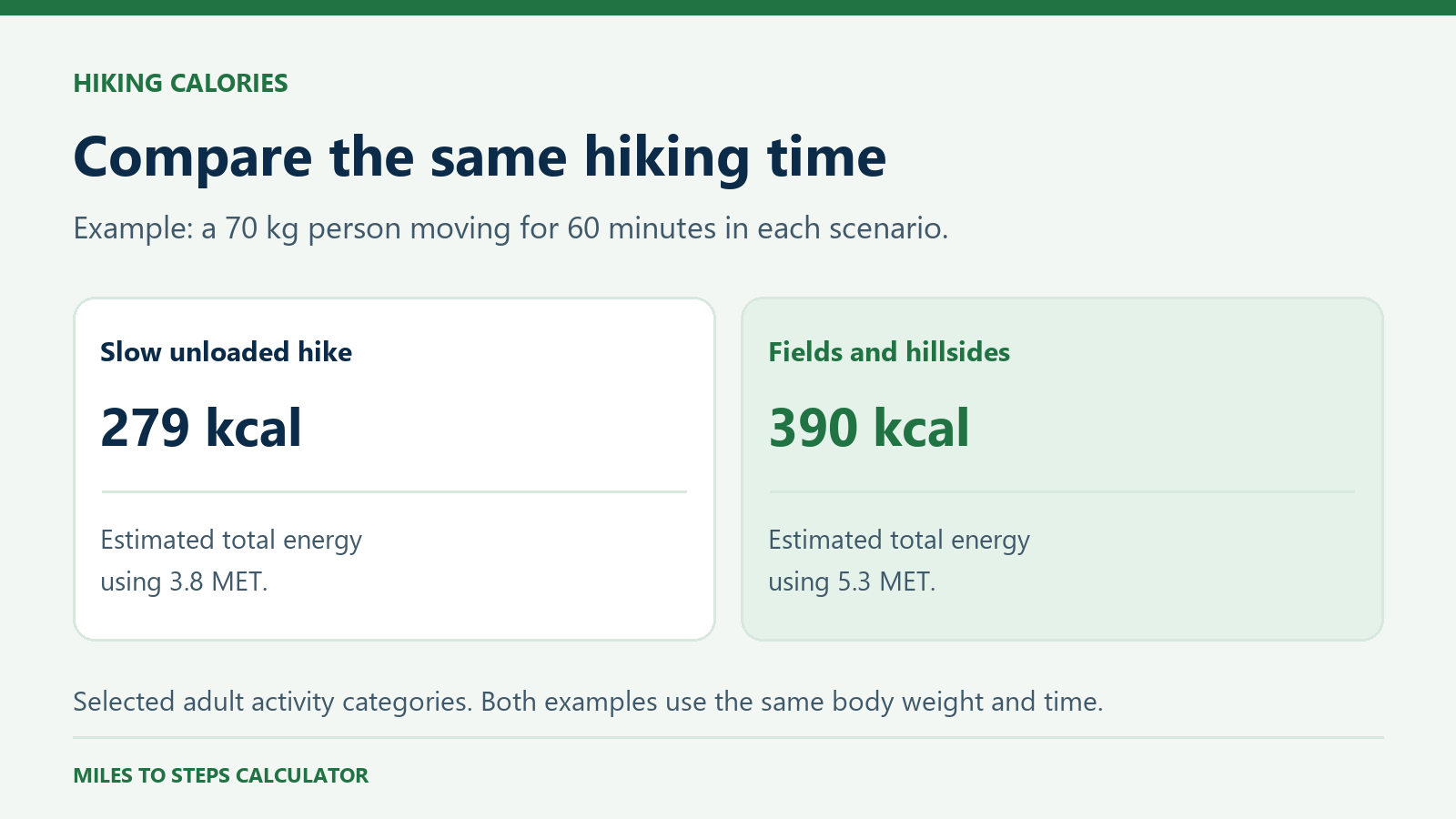
It can, but compare the same person and the same time period before drawing a conclusion. For a 70 kg person, 60 minutes at a selected level-walking intensity of 3.8 MET gives about 279 total kcal. Sixty minutes at the 5.3 MET hiking example gives about 390. This shows the effect of the two selected categories, not a guaranteed difference between every walk and hike.
A gentle, slow hike and a very brisk pavement walk may not follow the same ordering. Comparing a three-hour hike with a twenty-minute walk also mixes intensity with duration. Decide whether you mean calories per minute, per mile or for the entire outing.
The Calories Burned Walking Calculator covers level walking scenarios, while the hiking tool offers terrain and load-related activity categories. For an inclined treadmill walk, use the Incline Walk Calorie Calculator within its stated limits.
Does walking with a backpack burn more calories?
Carrying a load can increase the work involved, but the result depends on the load, route, pace and how long you move. “With a backpack” is not a complete activity description: a light daypack on level ground differs from a loaded uphill backpacking trip.
Our calculator represents load through the selected activity category. Enter your body weight, not body weight plus backpack weight. Adding the pack to body weight and selecting a loaded category would mix two adjustments without a validated basis. There is also no separate percentage uplift to add on top of the result.
For a consistent 70 kg, one-hour example, choosing the 7.0 MET backpacking category gives about 515 total kcal and 441 active kcal. That figure is not a recommendation to carry more weight. The category describes a broader activity pattern, so it cannot isolate the effect of adding a specific number of kilograms to your pack.
Total and active hiking calories
Total calories include the standardized resting component during the same minutes. Active calories subtract that component using MET − 1. For our 70 kg, one-hour 5.3 MET example, the difference is about 74 kcal: 390 total versus 316 active.
A watch, app or treadmill may define these labels differently. Do not compare one device’s active calories with another tool’s total calories and assume the difference is a measurement failure. Neither value alone predicts weight change or determines the food or fluids needed for a particular trip.
Hiking calorie questions
How many calories does hiking uphill burn?
There is no single uphill value. Grade, speed, load and moving duration need to match the estimation method. A general hiking category gives a broad approximation, not a detailed reconstruction of each climb.
Should I count a lunch stop as hiking time?
Exclude it from a moving-hiking calculation. Energy expenditure during a stationary break is a separate activity, and applying the hiking MET value would give that break the wrong assumed intensity.
Can I calculate a hike from step count alone?
Steps alone do not specify terrain, load or duration. A step-based level-walking estimate may miss the conditions that make a hike different. Use your route and moving-time information when available.
Sources and calculation notes
Activity categories and their limitations are linked above. The 2024 Adult Compendium paper explains the framework. All tables here are calculated scenarios with stated inputs, not field measurements or individualized medical advice. Published November 7, 2026 by Miles to Steps Calculator. Methodology · Report a correction.