
☰
Do You Need 10,000 Steps a Day? What the Research Says
10,000 steps is not a universal daily requirement. Step research reports population associations, while public activity guidance also considers time and intensity.
Use our distance-to-steps tool to apply your own measurement.
What research can and cannot establish
Paluch and colleagues’ 2022 meta-analysis of 15 cohorts found that higher daily step counts were associated with lower all-cause mortality, with patterns differing by age. Observational associations do not prove that assigning a particular target causes a specific outcome for an individual.
A 2025 systematic review of daily steps and health outcomes also examined a range of outcomes. Its evidence does not turn one number into a personal prescription.
Steps are one way to describe movement
CDC adult guidance is expressed in activity minutes and muscle-strengthening days rather than a universal step count: at least 150 minutes of moderate activity or 75 minutes of vigorous activity per week, plus strengthening on two days. A step total alone does not show whether all those activity components are covered.
Turn a chosen goal into a practical plan
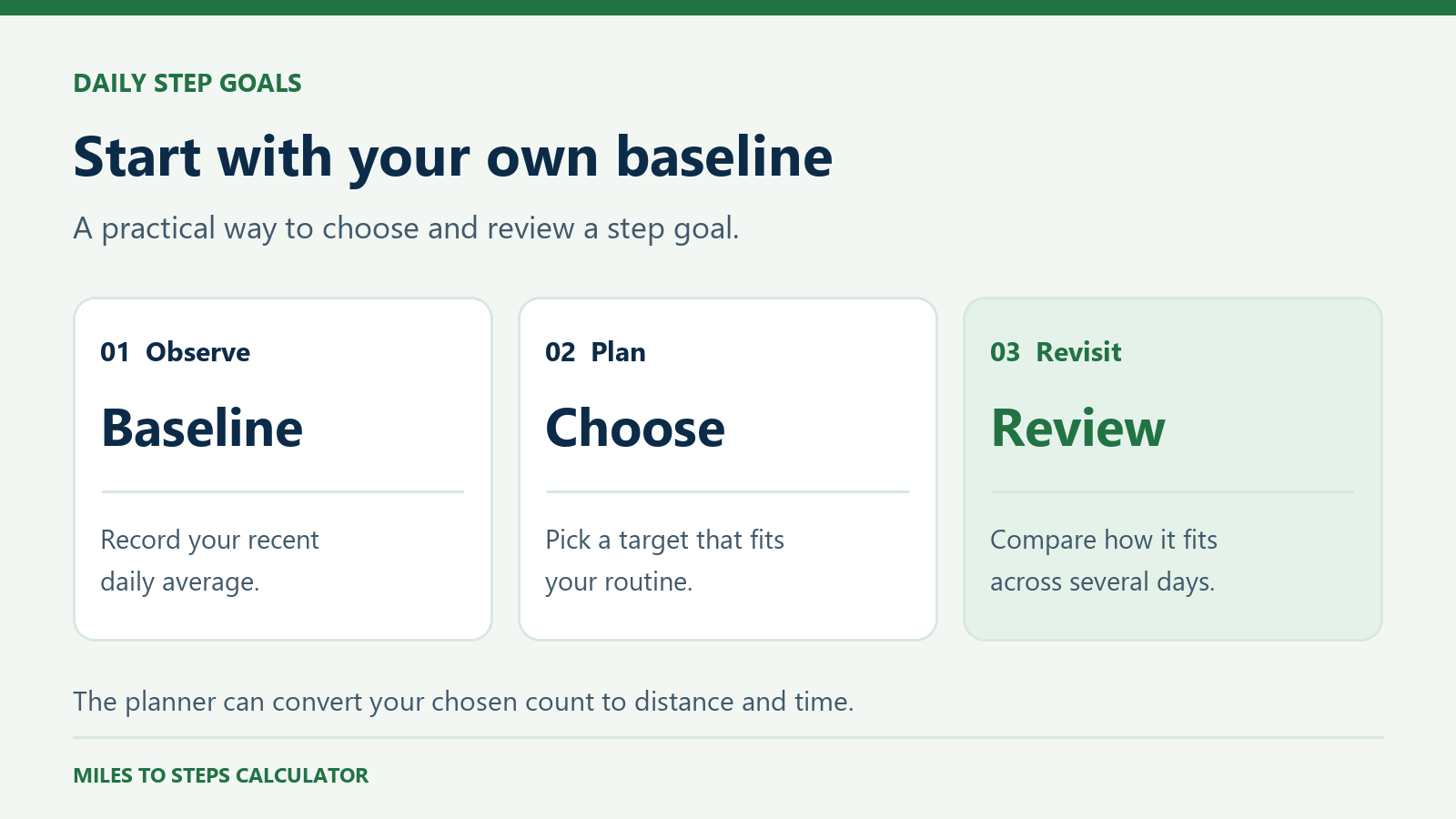
Start with your own recent average and choose a manageable target for your circumstances. The Daily Step Goal Planner translates your chosen steps into distance and time. Its progression is arithmetic; it does not select a medically appropriate goal.
Keep the limits in view
Research participants and measurement methods differ, and a tracker count is itself an estimate. If you need individual advice because of symptoms, a condition or a substantial activity change, discuss it with a qualified professional who knows your situation.
Method and corrections
Source records and calculation assumptions are in Methodology, Sources and Limits. Report an error or suggest a correction.
Try the main calculator
Convert miles or kilometres into steps with your measured step length or a rough walking estimate.
Open the Miles to Steps Calculator