
☰
Walking and distance guides
How Many Steps Are in a Mile?
At 2.5 feet per step, a mile is 2,112 steps. Compare example lengths, calculate your own count, and see how walking and running differ.
How many steps are in one mile?
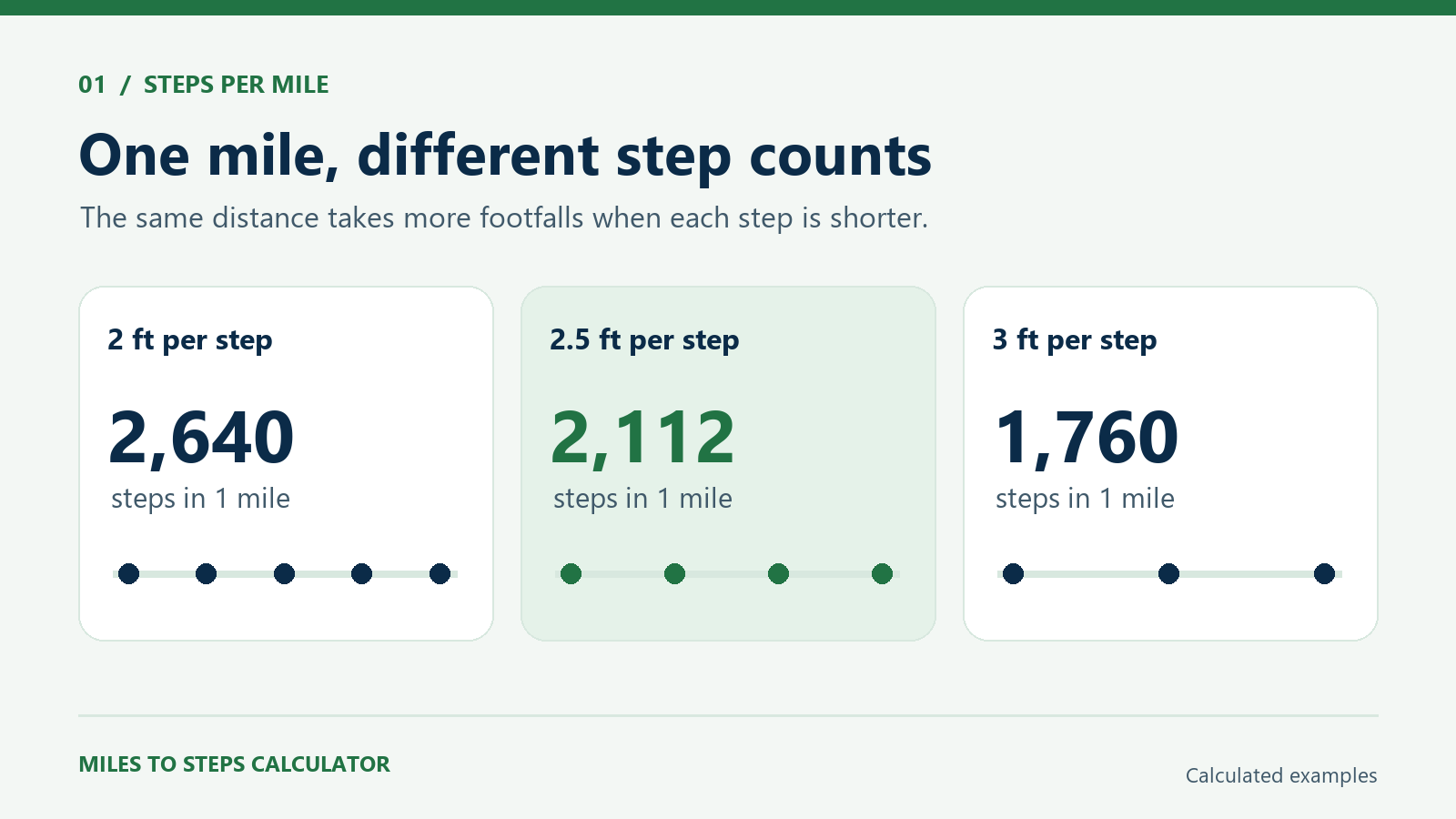
At 2.5 feet per step, one mile is 2,112 steps. At 2 feet per step it is 2,640 steps, and at 3 feet per step it is 1,760. These are arithmetic examples, not universal averages. The shorter the distance you advance with each footfall, the more footfalls it takes to cover the same mile.
“About 2,000 steps per mile” can be a quick shorthand if you only need a rough idea. It implies a step length of 2.64 feet, about 80.5 cm. If your own step length is closer to 65 cm, the same mile needs about 2,476 steps. A measured value is useful when the distinction matters, such as comparing a familiar route with your tracker or planning a distance from a step goal.
Enter your measured length in the Steps per Mile Calculator to calculate your personal ratio. To apply the same length to a longer route, use the Miles to Steps Calculator.
Calculate steps per mile from step length
A mile is exactly 5,280 international feet, 63,360 inches or 1,609.344 metres. NIST’s conversion definitions provide the mile and foot constants. Match the units of the mile to the units of your step length before dividing.
Steps per mile = distance in one mile ÷ distance per step. With feet, divide 5,280 by feet per step. With inches, divide 63,360 by inches per step. With centimetres, divide 160,934.4 by centimetres per step. A 30-inch step is 2.5 feet or 76.2 cm, so all three calculations give 2,112.
A step runs from one footfall to the next, for example left heel to right heel. A full stride runs from one foot to its next landing, such as left heel to left heel. It contains two steps. If your tape measures a 5-foot full stride, its two steps average 2.5 feet each. Entering 5 feet as the length of one step would halve the estimate. Some devices use the label “stride length” for a per-step input, so check what the field actually means.
Steps per mile by measured step length
Choose the row closest to your measured single step. The metric values in this table are exact conversions of the feet shown; step totals are rounded at the end. These are example lengths rather than percentiles, recommendations or a normal range.
| Feet per step | Centimetres per step | Steps per mile |
|---|---|---|
| 1.75 | 53.34 | 3,017 |
| 2 | 60.96 | 2,640 |
| 2.25 | 68.58 | 2,347 |
| 2.5 | 76.20 | 2,112 |
| 2.75 | 83.82 | 1,920 |
| 3 | 91.44 | 1,760 |
| 3.25 | 99.06 | 1,625 |
| 3.5 | 106.68 | 1,509 |
Notice how the result changes around 2.5 feet. Using 2.25 feet instead adds about 235 estimated steps per mile. Over five miles that difference grows to roughly 1,173 steps if both people maintain the same lengths. A small input difference can therefore matter more over a long route than it does on a short one.
Measure your own steps per mile
The most direct method is to count footfalls on a measured mile at your normal pace. If you have a shorter measured course, you can scale its result. For example, suppose you count about 526 steps over a measured 400 metres. Dividing 400 by 526 gives a mean step length of approximately 0.7605 m. Scaling the count to a mile gives 526 × 1,609.344 ÷ 400 ≈ 2,116 steps per mile.
Use a known course rather than a distance inferred from the same step-length setting you are trying to check. Begin moving before the measured section and continue past the end so the measurement reflects your steady pace. Count the landings consistently at the start and finish, repeat the route, and compare the results. A single footfall near a boundary can change a short test more than a longer one.
The step-length measurement guide explains how to count intervals between marked footprints and how to combine repeated trials. If you prefer to enter distance and steps directly, use the Step Length Calculator.
Walking versus running a mile
The mile itself does not change. What changes is how far you advance on each step. For example, someone who walks with a 0.75 m step would estimate about 2,146 steps per mile. At a separately measured running step length of 1.00 m, the same person would estimate about 1,609 running steps per mile. Those lengths are illustrative; the difference is not a fixed running adjustment.
Running cadence and walking cadence are also different quantities from steps per mile. Cadence counts steps per minute. You can take more steps per minute while covering the mile in fewer steps if your step length increases enough. A pace change may alter cadence, step length or both. See What Changes Your Step Length? for examples at equal and unequal speeds.
For a run–walk route, estimate each segment with the length appropriate to that segment, then add the estimates. Applying your brisk walking length to every part of an interval session can give the wrong total even when the overall route distance is known.
Can height tell you how many steps are in a mile?
Height can supply a starting assumption when you have no measurement. Our optional walking estimate uses step length = 0.42 × height, in matching units. At 170 cm it assumes 71.4 cm per step, giving about 2,254 steps per mile. This is a model result, not a measurement of a person who is 170 cm tall.
Barreira, Rowe and Kang’s study of healthy young adults compared estimated and observed walking step lengths and found a significant difference. It supports treating a height shortcut cautiously rather than assigning everyone the same accurate multiplier. People of the same height can move differently, and the walking shortcut is not used to estimate running length.
The Steps per Mile Chart by Height shows what that disclosed model produces at other heights. Replace the assumption with your own measurement when possible.
Why your watch and the calculator might disagree
The calculator estimates steps from a distance and length. A device instead detects or infers footfalls from sensor signals. Its distance can come from GPS, an estimated step length, a treadmill or another source. Two different inputs can therefore produce two different numbers without either being a direct measure of everything that happened.
For a useful check, compare the same segment of a known route. Start and stop the recording at consistent points, note whether the tracker counts before or after the selected interval, and check that it is set to the correct activity and units. The step-counter accuracy guide explains why placement and movement patterns matter.
Use the result for distance or time planning
If you know your own steps per mile, multiply it by miles to estimate steps for a comparable route. For example, 2,112 steps per mile × 3 miles = 6,336 steps. To work backwards, divide steps by your ratio. At that same length, 10,000 steps ÷ 2,112 steps per mile ≈ 4.73 miles. The 10,000-steps distance guide shows how that result changes with length.
A step count does not by itself tell you how long the mile takes. The walking-time guide uses speed and duration instead. It also separates moving time from time spent at crossings or taking breaks.
Steps-per-mile questions
Is a mile always 2,000 steps?
No. That count corresponds to about 80.5 cm per step. A shorter step length raises the count for the same mile.
How many steps are in half a mile?
At 2.5 feet per step, half a mile is 1,056 steps. In general, divide 2,640 feet by your step length in feet.
Does a taller person always take fewer steps per mile?
No. Fewer steps follow from a longer measured step, regardless of height. Height alone does not determine the length used on a particular walk.
Sources and calculation notes
Unit definitions and the walking study are linked where they are used. The table contains calculated scenarios and does not describe a sample of measured walkers. Site methodology · Report a correction.