
☰
Walking and distance guides
How Long Does It Take to Walk a Mile? Walking Time Chart by Distance
A mile takes 20 minutes at 3 mph. Compare walking times for common distances and a 5K, with clear speed assumptions and allowances for stops.
How long does it take to walk one mile?
At a steady 3 mph, walking one mile takes 20 minutes. At 2 mph it takes 30 minutes, at 2.5 mph it takes 24 minutes, and at 4 mph it takes 15 minutes. These are calculations for continuous movement, not a measured average for every walker. Your journey can take longer when you include crossings, rests or an uphill route.
If you are searching for an average time to walk a mile, start with a range that matches the speed you can sustain rather than treating one number as a target. The 15–30-minute examples here cover 2–4 mph; a slower pace is perfectly possible. A familiar, measured route is a better starting point for your own estimate than someone else’s fastest mile.
Use the Walking Time Calculator for a distance and speed of your choice. This guide explains duration. For the number of footfalls, see How Many Steps Are in a Mile?
Walking-time chart by distance
The table assumes a constant speed on a route where that speed is practical. It excludes breaks. Hours and minutes are rounded to the nearest minute, so calculate with the unrounded distance when precision matters.
| Distance | 2 mph | 2.5 mph | 3 mph | 4 mph |
|---|---|---|---|---|
| ½ mile | 15 min | 12 min | 10 min | 8 min |
| 1 mile | 30 min | 24 min | 20 min | 15 min |
| 2 miles | 1 hr | 48 min | 40 min | 30 min |
| 3 miles | 1 hr 30 min | 1 hr 12 min | 1 hr | 45 min |
| 4 miles | 2 hr | 1 hr 36 min | 1 hr 20 min | 1 hr |
| 5 miles | 2 hr 30 min | 2 hr | 1 hr 40 min | 1 hr 15 min |
| 6 miles | 3 hr | 2 hr 24 min | 2 hr | 1 hr 30 min |
| 7 miles | 3 hr 30 min | 2 hr 48 min | 2 hr 20 min | 1 hr 45 min |
| 8 miles | 4 hr | 3 hr 12 min | 2 hr 40 min | 2 hr |
| 10 miles | 5 hr | 4 hr | 3 hr 20 min | 2 hr 30 min |
| 12 miles | 6 hr | 4 hr 48 min | 4 hr | 3 hr |
| 13.1 miles | 6 hr 33 min | 5 hr 14 min | 4 hr 22 min | 3 hr 17 min |
| 15 miles | 7 hr 30 min | 6 hr | 5 hr | 3 hr 45 min |
| 20 miles | 10 hr | 8 hr | 6 hr 40 min | 5 hr |
| 26.2 miles | 13 hr 6 min | 10 hr 29 min | 8 hr 44 min | 6 hr 33 min |
For example, five miles at 3 mph needs 1 hour 40 minutes of moving time. With a 10-minute rest and two 3-minute stops, the estimated elapsed time becomes 1 hour 56 minutes. For eight miles at 2.5 mph, moving time alone is 3 hours 12 minutes. A pace comfortable for a short trip may be harder to maintain over those longer distances.
The long-distance rows are arithmetic references. They do not imply that a marathon-distance walk is suitable preparation for a beginner or that breaks can be ignored on a long day.
Calculate time from speed or pace
Minutes = distance in miles ÷ speed in mph × 60. In metric units, use distance in kilometres ÷ speed in km/h × 60. Keep the units matched. Dividing kilometres by mph without converting them will produce the wrong time.
For three miles at 2.5 mph: 3 ÷ 2.5 × 60 = 72 minutes, or 1 hour 12 minutes. The same speed expressed as pace is 60 ÷ 2.5 = 24 minutes per mile. Multiply three miles by 24 minutes per mile to reach the same answer.
If you know your pace, time = distance × pace. A pace of 18:30 per mile means 18.5 minutes per mile, not 18.30. At that pace, two miles take 37 minutes. In the opposite direction, divide total minutes by miles to find average pace, or divide miles by hours to find average speed.
How long does it take to walk a 5K?
A 5K is five kilometres, approximately 3.1069 miles. At 3 mph it takes about 62 minutes of continuous walking. At 2 mph the estimate is 93 minutes; at 2.5 mph it is 75 minutes; at 3.5 mph it is 53 minutes; and at 4 mph it is 47 minutes. These values use the full conversion before rounding.
For a walking event, check whether the advertised limit uses time from the starting gun or your own start, and whether the finish area closes at a fixed time. Allow for the start queue and any aid-station stops. A 5K route with a substantial hill can take longer than a flat 5K at your usual effort.
A 10K doubles the distance, but it does not guarantee you can maintain the same pace. Read How Far Is a 10K? for the race-distance comparison, then use a realistic sustained walking speed to estimate its duration.
Moving time versus elapsed time
Moving time counts the periods when you are progressing along the route. Elapsed time counts everything from departure to arrival. An app that automatically pauses can show a quicker pace than the pace implied by the clock on the wall.
For an appointment, use elapsed time. Add your likely waits at traffic lights, time spent finding the entrance and any planned rest. For comparing two training walks, use the same definition of time on both. Otherwise an apparent improvement may simply reflect different pause settings.
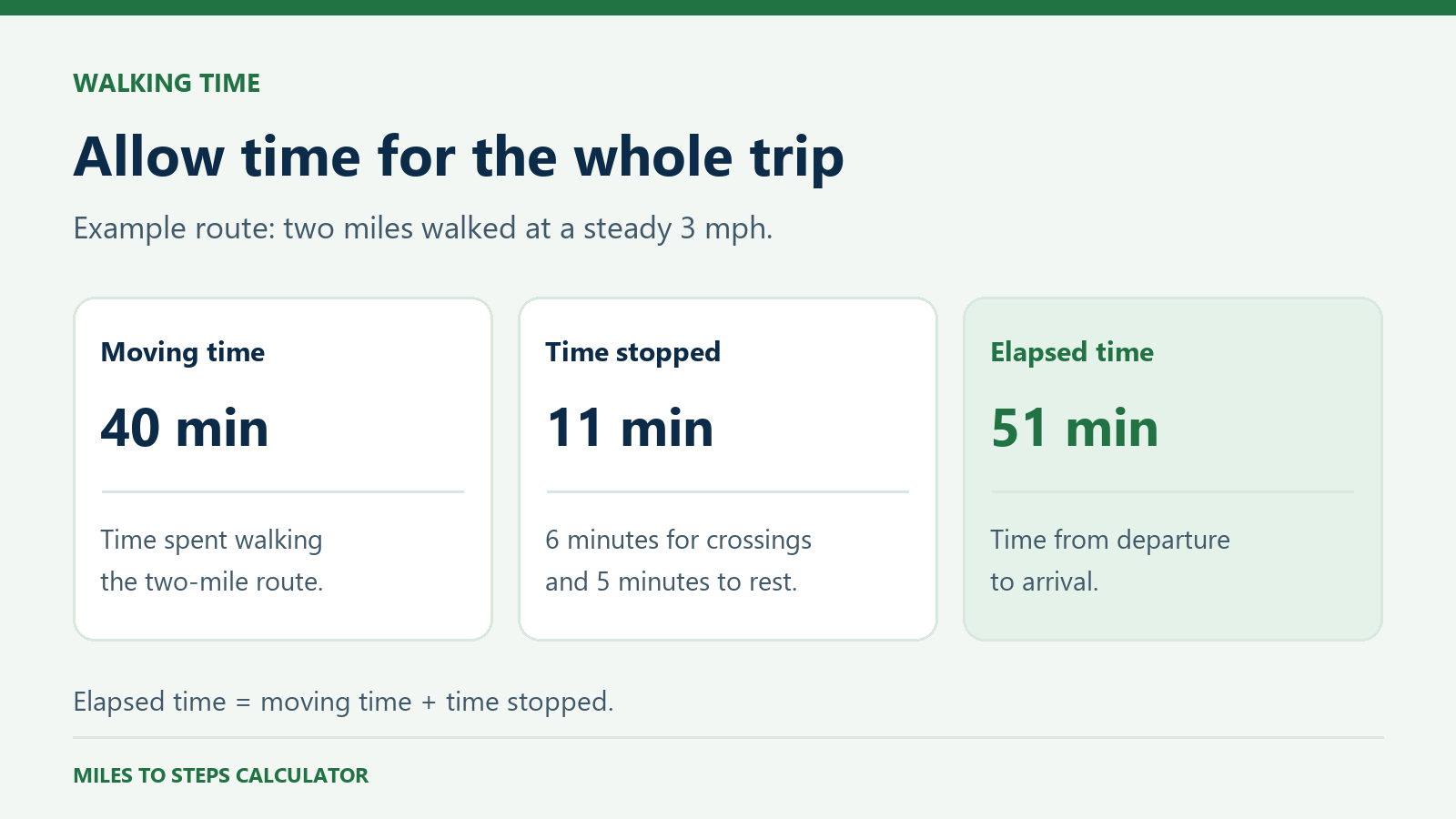
Consider a two-mile route at 3 mph. The walking calculation gives 40 minutes. If crossings add 6 minutes and a rest adds 5, plan for 51 minutes before adding any arrival buffer you personally need. Those stop allowances are an example, not a universal rule.
What changes walking completion time?
Pace and the ability to sustain it
A faster first mile does not necessarily predict a faster whole route. If you slow later, calculate separate sections or use the average speed from comparable longer walks. Avoid describing a single pace as the right pace for everyone. The CDC’s intensity guidance uses breathing and the talk test to describe effort, which can differ between people even at the same speed.
Terrain and elevation
Hills, loose stones, mud, sand and steps can reduce forward speed. A level pavement estimate is not a hiking-time model. Break a mixed route into sections if necessary: calculate the level portion at one speed and the hill at a slower speed, then add stops. Do not assume that a descent recovers every minute lost on the climb.
Fitness, fatigue and conditions
Recent walking experience, mobility, fatigue, heat and the items you carry can change your comfortable pace. Choose an estimate that reflects the conditions of this trip. If you are walking with others, the group’s practical pace matters more than your solo pace.
Find a useful personal walking pace
- Choose a known distance that resembles the route you want to plan.
- Time it at your normal, sustainable walking effort.
- Record both moving time and total elapsed time if stops are common.
- Repeat on another day, then use a realistic range rather than your single best attempt.
- Recheck when the route, distance or conditions change substantially.
A measured mile completed in 22 minutes corresponds to 22 minutes per mile and about 2.73 mph. It predicts 66 minutes for three miles only if you can sustain that pace and the conditions remain comparable. With several recent observations, you might plan using the slower end when arriving on time matters.
The Walking Speed Calculator converts a completed route into speed and pace. A step count alone cannot determine walking time: you also need cadence, or distance together with speed.
Walking-time questions
Can I walk a mile in 15 minutes?
That requires an average speed of 4 mph while moving. It is an arithmetic relationship, not a promise that this pace will be comfortable or sustainable for you.
How many minutes is half a mile?
At 3 mph it is 10 minutes. At 2 mph it is 15 minutes, and at 4 mph it is 7 minutes 30 seconds before rounding.
How long is a ten-mile walk?
At 3 mph, moving time is 3 hours 20 minutes. At 2.5 mph it is 4 hours. Add breaks and allow for a pace change over a long route.
Does 10,000 steps mean a fixed walking time?
No. Step length determines the distance covered, and cadence or walking speed determines duration. Daily steps can also be spread across many short bouts with long pauses between them.
Sources and calculation notes
Distance conversions follow NIST’s international-foot and mile definitions. All table times are calculated examples using distance ÷ speed, not population averages. The CDC source above explains relative effort rather than predicting an individual’s walking speed. Published November 7, 2026 by Miles to Steps Calculator. Methodology · Suggest a correction.