
☰
Walking and distance guides
What Changes Your Step Length? Walking, Running and Speed
Step length changes with speed, cadence, activity and terrain. Compare walking and running examples and learn when to measure again.
What changes your step length?
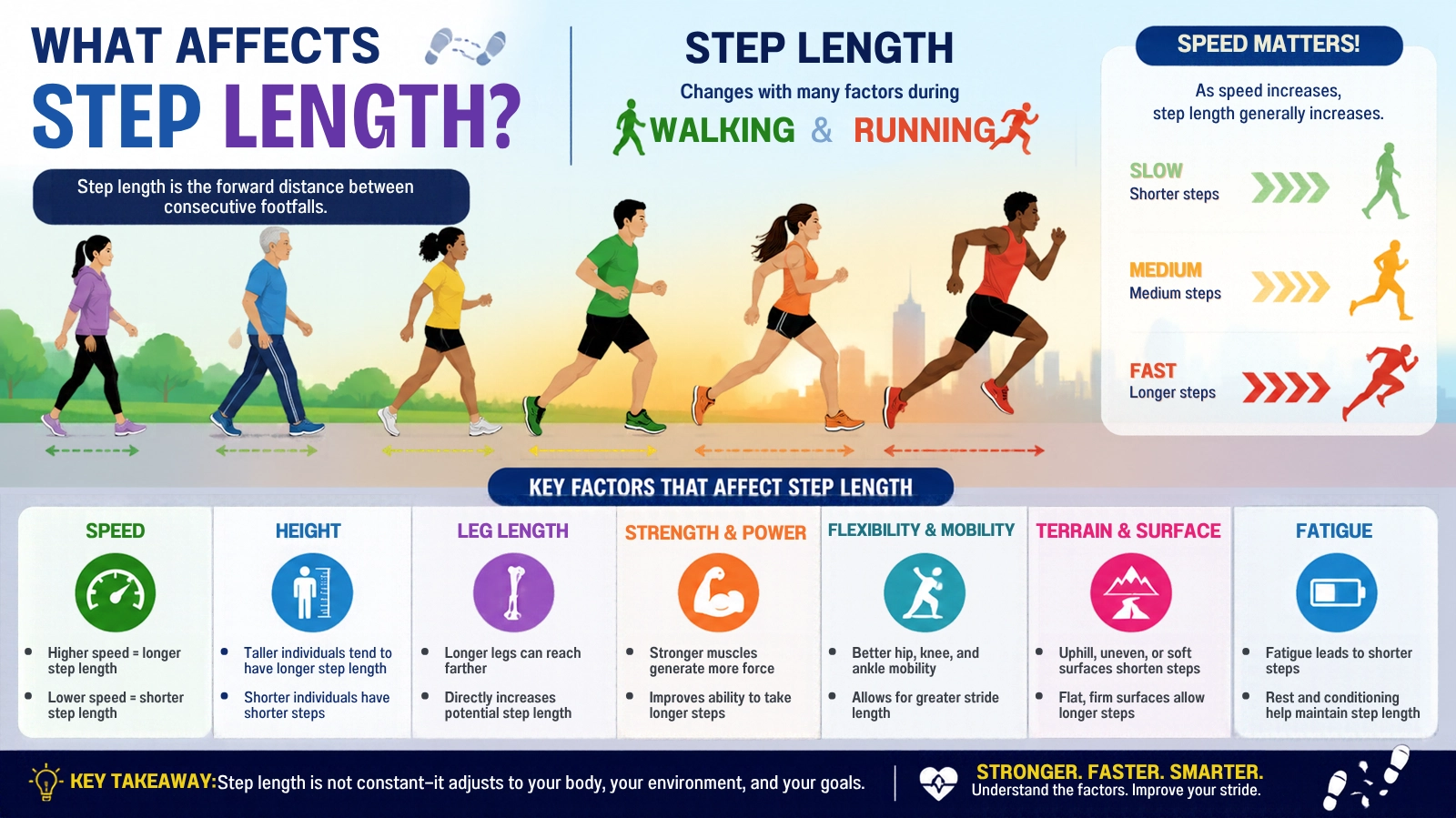
Step length is how far you move forward between successive footfalls. It can change with speed, the choice to walk or run, the surface and how you move on a particular day. Height and leg length help explain why people differ, but they do not determine the length of every step a person takes.
The useful question for a calculator is how far you advance per step in the activity you are estimating. Your easy walking length may not work for a brisk walk, a run or a day of short indoor movements. A representative measurement is more useful than a universal walking-to-running multiplier.
For measuring your own length, follow the step-length measurement guide or enter measured distance and steps in the Step Length Calculator.
How step length, cadence and speed fit together
Speed in metres per minute = metres per step × steps per minute. Cadence is the count of footfalls per minute. Step length is the distance of one footfall interval. Full stride length spans two successive steps, so it does not belong in this equation unless you count full strides instead of steps.
If you take 100 steps per minute at 0.70 m per step, you cover 70 m in a minute, which is 4.2 km/h. Raising cadence to 120 while keeping length unchanged gives 84 m per minute, or 5.04 km/h. Keeping cadence at 120 and increasing length to 0.80 m gives 96 m per minute, or 5.76 km/h.
These combinations illustrate the arithmetic. They are not preferred cadences or instructions to lengthen your step. A single speed reading does not reveal how the movement was produced: many pairs of step length and cadence give the same product.
| Metres per step | Steps per minute | Metres per minute | Speed (km/h) |
|---|---|---|---|
| 0.70 | 100 | 70 | 4.20 |
| 0.70 | 120 | 84 | 5.04 |
| 0.80 | 120 | 96 | 5.76 |
| 1.00 | 160 | 160 | 9.60 |
The Cadence Calculator connects a counted interval with steps per minute. The Walking Speed Calculator uses route distance and time. Use each input only for what it measures.
Does walking faster mean taking longer steps?
It can. People can walk faster by increasing cadence, lengthening steps or changing both. A laboratory study by Paróczai and Kocsis examined how walking and running parameters varied with speed. Its measurements help explain why a single length should not be treated as fixed across all speeds.
Compare your own easy and brisk walks on the same course. Suppose 400 m takes 570 steps at an easy pace and 520 at a brisk pace. The lengths are about 70.2 cm and 76.9 cm respectively. If you also timed each trial, you could tell whether cadence increased as well. Without timing, the counts establish mean lengths but do not identify the cadence.
Do not use the first few steps after a stop as your steady walking measurement. Research on transitions between walking speeds found that the transition step could differ from the steps immediately before and after it. An approach and run-out area makes it easier to measure the pace you intend to use.
Walking and running are different movement patterns
A person may use different cadences and step lengths for walking and running. A separately measured running step can be longer than a walking step, but the difference is not fixed. An easy shuffle and a fast run can have different lengths even though both are called running. A brisk walk can also differ from a relaxed stroll.
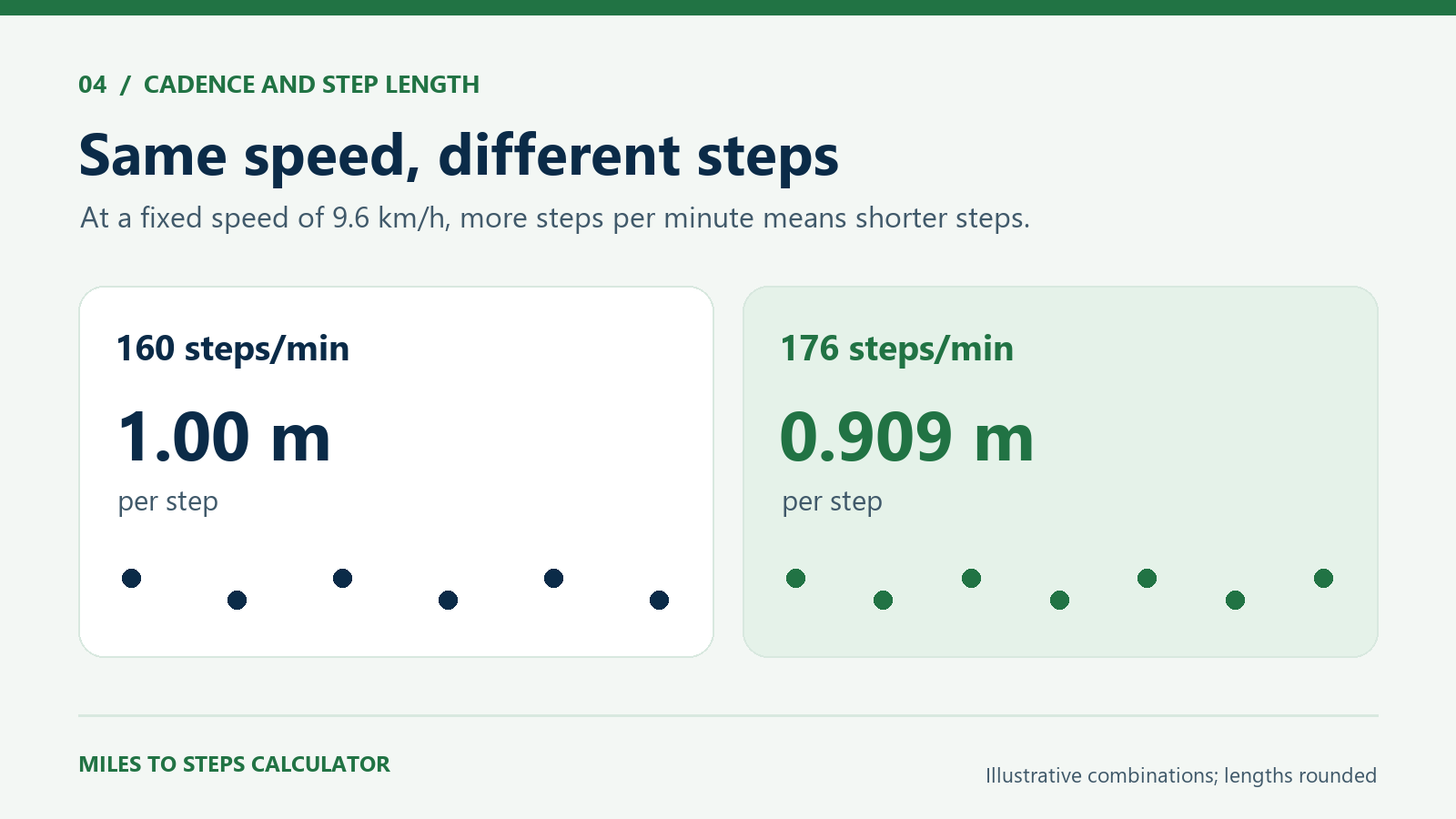
At a fixed speed, a higher cadence requires a shorter average step. For example, 9.6 km/h is 160 metres per minute. At 160 steps per minute that works out to 1.00 m per step. At 176 steps per minute, the same speed works out to approximately 0.909 m per step. The calculation holds speed constant; the new cadence is not a recommendation.
Heiderscheit and colleagues experimentally changed step rate during running at a controlled speed and observed shorter steps when cadence increased. That study supports the relationship under its conditions, not one ideal cadence for all runners or a promise about injury prevention.
Height and leg length influence the possibilities
People with different body dimensions can prefer different lengths at their usual pace. But comparing height alone leaves out gait, speed and the particular route. A taller person taking short steps can cover less distance per footfall than a shorter person walking briskly.
The site’s height shortcut assumes a walking step of 42% of height. For 180 cm, it assumes 75.6 cm. If the actual measured step is 70 cm, a mile takes about 2,299 steps rather than the height-based estimate of about 2,129. The input assumption causes the difference; both calculations use the same mile.
A study comparing estimated and measured step length found that the height estimate did not match the group’s observed lengths closely enough to treat it as a personal measurement. Use the height chart as a scenario reference and measure your own length when the difference matters.
Terrain, treadmill settings and interruptions
Loose or uneven surfaces, sharp turns, crowded paths and changes in grade can alter the steps you choose. The effect is not the same for every person or slope. A route with repeated stops also contains acceleration and deceleration steps that may not resemble steady movement on a straight path.
When comparing a treadmill with an outdoor walk, record the actual conditions. Belt speed, incline, surface, familiarity and device placement can all affect how useful the comparison is. A study of indoor, outdoor and treadmill walking compared gait measurements across those settings; it does not supply a single correction that applies to every walker and machine.
If you want to estimate steps for a particular treadmill session, a measurement taken in that setting is more representative than assuming an outdoor step length will transfer exactly. To convert the console’s speed to pace, use the treadmill pace chart. For differences in step detection, see Treadmill vs Outdoor Walking.
Why measurements can change across the same outing
A short measurement at the beginning of a walk describes that sample, not necessarily the final mile. Fatigue, walking with a group, carrying a bag or slowing on a rough section may change your pace and the balance between length and cadence. Rather than assuming a fixed percentage change, record the condition when you take the measurement.
If two consistent trials differ a little, retain a reasonable range. A 0.72–0.76 m walking length implies roughly 2,118–2,235 steps per mile. The shorter length gives the higher step count. This is a sensitivity range from your input choices, not a statistical confidence interval or an assessment of gait quality.
When to measure again and what to record
- Switching activity: save separate values for walking and running.
- Changing pace: compare a normal walk and a brisk walk on the same measured section.
- Changing surface: use a route or treadmill condition that resembles the session you want to estimate.
- Comparing over time: repeat the same course and counting method before interpreting a change.
A simple log can include route distance, number of footfalls, moving time, surface and a brief description of your pace. Divide distance by steps for length, steps by minutes for cadence, and distance by minutes for speed. Comparing all three helps you identify which input changed rather than guessing from a watch summary alone.
After measuring, use the steps-per-mile guide for the conversion. Remember that a change in estimated steps does not by itself tell you whether one movement pattern is better for you.
Walking, running and step-length questions
Does higher cadence always mean longer steps?
No. At a fixed speed, higher cadence means shorter steps. If speed changes too, use the measured distance and count to find the actual length.
Is my running step always twice my walking step?
No. Measure each activity separately. The full-stride versus single-step distinction is the only two-step relationship used here; it is not a multiplier for running versus walking.
Can the same person have two valid step-length measurements?
Yes. Both can be valid for the particular pace, activity and surface measured. Label each measurement so you use the right one in a calculator.
Sources and limits
The primary studies linked above address specific populations and testing conditions. The numeric scenarios here are worked examples, not universal gait norms or training prescriptions. Site methodology · Report a correction.