
☰
Walking and distance guides
Treadmill Pace Chart: MPH, Minutes per Mile and Minutes per KM
Convert treadmill mph and km/h to minutes per mile and kilometre. Use the reference chart, reverse formulas and worked session examples.
Treadmill speed to pace: the quick answer
A treadmill setting of 3.5 mph corresponds to about 17:09 per mile and 10:39 per kilometre. At 4 mph the pace is 15:00 per mile; at 5 mph it is 12:00; at 6 mph it is 10:00; at 7 mph it is about 8:34; and at 8 mph it is 7:30. These are distance-and-time conversions, not labels prescribing when someone must walk or run.
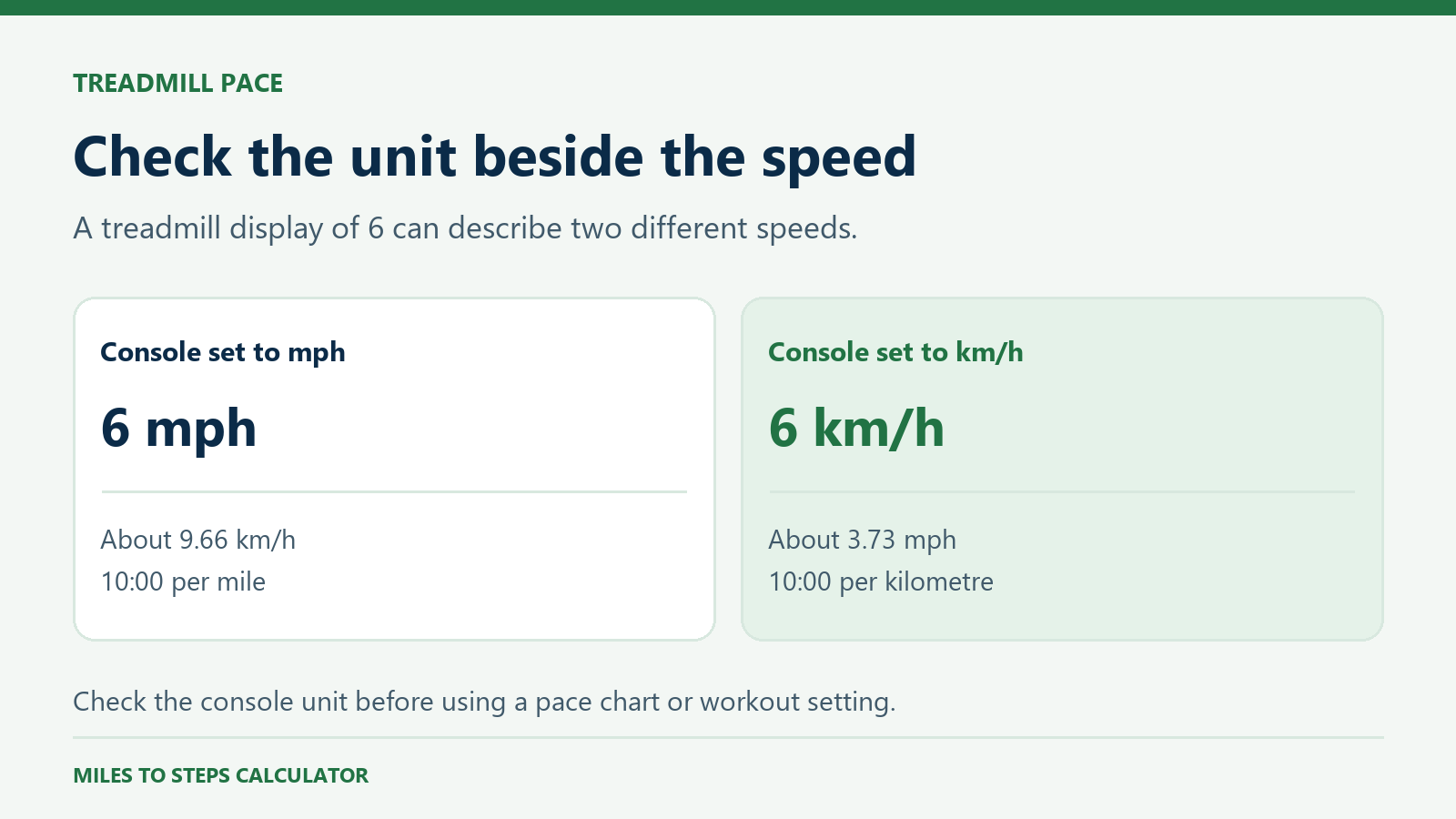
Check the console’s units before using any chart. A setting of 6 km/h is approximately 3.73 mph, so it is substantially slower than 6 mph. Many consoles show only a small unit symbol near the number. Changing from miles to kilometres changes the displayed number even when the belt’s physical speed is unchanged.
For an exact setting or a mixed session, open the Treadmill Pace Calculator. This guide keeps its focus on speed and pace. The effect of speed on footfall length belongs in What Changes Your Step Length?
Speed and pace describe the same movement differently
Speed is distance covered in a unit of time: miles per hour or kilometres per hour. A higher speed means more distance in the same hour. Pace is time taken to cover a unit of distance: minutes per mile or minutes per kilometre. A lower pace number means you cover that distance sooner.
At 3 mph you cover three miles in an hour. Each mile therefore takes one third of an hour, or 20 minutes. At 6 mph, each mile takes 10 minutes. Doubling speed halves pace; increasing speed by one mph does not subtract the same number of minutes at every starting speed.
Be careful with how time is written. A pace of 9:30 means nine minutes and thirty seconds, or 9.5 decimal minutes. It does not mean 9.30 decimal minutes. That distinction matters when you work backwards from a desired pace to a treadmill speed.
Treadmill pace chart: mph, km/h and both pace units
This single reference chart uses the exact conversion 1 mile = 1.609344 kilometres. Speeds in km/h are rounded to two decimals; paces are rounded to the nearest second from unrounded values. The chart describes the indicated belt speed. It does not adjust for incline, calibration error or outdoor effort.
| mph | km/h | min/mile | min/km |
|---|---|---|---|
| 1 | 1.61 | 60:00 | 37:17 |
| 1.5 | 2.41 | 40:00 | 24:51 |
| 2 | 3.22 | 30:00 | 18:38 |
| 2.5 | 4.02 | 24:00 | 14:55 |
| 3 | 4.83 | 20:00 | 12:26 |
| 3.5 | 5.63 | 17:09 | 10:39 |
| 4 | 6.44 | 15:00 | 9:19 |
| 4.5 | 7.24 | 13:20 | 8:17 |
| 5 | 8.05 | 12:00 | 7:27 |
| 5.5 | 8.85 | 10:55 | 6:47 |
| 6 | 9.66 | 10:00 | 6:13 |
| 6.5 | 10.46 | 9:14 | 5:44 |
| 7 | 11.27 | 8:34 | 5:20 |
| 7.5 | 12.07 | 8:00 | 4:58 |
| 8 | 12.87 | 7:30 | 4:40 |
| 8.5 | 13.68 | 7:04 | 4:23 |
| 9 | 14.48 | 6:40 | 4:09 |
| 9.5 | 15.29 | 6:19 | 3:55 |
| 10 | 16.09 | 6:00 | 3:44 |
| 11 | 17.70 | 5:27 | 3:23 |
| 12 | 19.31 | 5:00 | 3:06 |
For example, the 5 mph row means about 8.05 km/h, 12:00 per mile and 7:27 per kilometre. It does not mean a kilometre takes twelve minutes. Check both the number and the unit when copying a pace into a watch or a workout plan.
Convert treadmill mph to minutes per mile or kilometre
Minutes per mile = 60 ÷ mph. At 4 mph, 60 ÷ 4 = 15 minutes per mile. At 3.5 mph, the answer is 17.142857 minutes: keep the whole 17 minutes, multiply the remaining 0.142857 by 60, and round to get 17:09.
Minutes per kilometre = 60 ÷ km/h. If you start with mph, first multiply by 1.609344 to get km/h. At 6 mph, the speed is 9.656064 km/h, and the pace is about 6.2137 minutes per kilometre, or 6:13.
You can also divide minutes per mile by 1.609344 to obtain minutes per kilometre. Work with decimal minutes until the final step. Converting a previously rounded chart value repeatedly can introduce a few seconds of error, especially over a long distance.
Convert a target pace back into treadmill speed
Mph = 60 ÷ decimal minutes per mile. A target of 12:00 per mile gives 60 ÷ 12 = 5 mph. A target of 9:30 per mile gives 60 ÷ 9.5 ≈ 6.32 mph. If your treadmill only permits 0.1 mph increments, 6.3 mph is the nearer setting; it will produce a slightly different pace.
For a metric target, km/h = 60 ÷ decimal minutes per kilometre. A target of 6:00 per kilometre is 10 km/h, approximately 6.21 mph. If the machine is set to mph, enter the converted speed rather than entering the number 10 without checking the unit.
A decimal pace can create an easy mistake: 8:45 is 8.75 minutes. Using 8.45 instead gives about 7.10 mph rather than the correct 6.86 mph. Convert the seconds to a fraction of a minute before dividing.
Use speed to estimate a session’s distance
Distance = speed × moving time in hours. Thirty minutes at 4 mph covers 2 miles. Twenty minutes at 6 mph also covers 2 miles. At an unchanged speed, doubling the duration doubles the indicated distance.
For intervals, calculate each portion separately and add the distances. Ten minutes at 3 mph covers 0.5 mile; ten minutes at 6 mph covers 1 mile. Together they cover 1.5 miles in 20 minutes, giving an average speed of 4.5 mph and an average pace of 13:20 per mile.
Do not average the two pace numbers, 20:00 and 10:00, for that equal-time example. Their simple average is 15:00, which would be wrong. Total time divided by total distance produces the appropriate overall pace. Use the Treadmill Distance Calculator or Run-Walk Interval Calculator when the session has several parts.
Why the same pace can feel different outdoors
The arithmetic chart stays the same indoors and outdoors: a mile completed in ten minutes is a ten-minute mile in either place. The effort needed to produce that time is a separate question. Air movement, the room’s temperature, surface properties, machine characteristics and how accustomed you are to treadmill movement can affect the experience.
A systematic review by Miller and colleagues found that physiological and perceived-effort differences between treadmill and overground running depended on the conditions and speed being compared. That research does not establish one universal correction for every walker, runner or machine.
Adding incline changes the task, but it does not change the speed-to-pace unit conversion. There is no need to add 1% incline just to read this chart, and the chart does not promise that any particular incline recreates your outdoor route. For footfall-count differences, see Treadmill vs Outdoor Walking.
Read the chart alongside your treadmill console
- Confirm whether the speed display uses mph or km/h.
- Distinguish current speed from the average speed of the whole session.
- Remember that warm-up, cool-down and pauses alter an overall pace.
- Use the manufacturer’s calibration and maintenance guidance if distance readings seem inconsistent.
- Record incline separately if you want to compare sessions at a similar workload.
A watch’s indoor distance estimate can differ from the console because the devices estimate distance differently. That disagreement alone does not identify which number is correct. A conversion chart can translate the speed you enter; it cannot independently measure belt movement or validate a wearable’s distance.
Common treadmill pace questions
What pace is 3.5 mph?
Approximately 17:09 per mile or 10:39 per kilometre. Over 30 minutes at that constant indicated speed, the distance is 1.75 miles.
Is 6 mph the same as 6 km/h?
No. Six mph is about 9.66 km/h. Six km/h is about 3.73 mph and a pace of 10:00 per kilometre.
Does incline change minutes per mile?
At a fixed indicated belt speed, the speed-to-pace calculation stays the same. Incline affects the effort and elevation component, which this conversion chart does not quantify.
Sources and calculation notes
NIST unit definitions provide the mile-to-kilometre factor. The treadmill/outdoor discussion cites the review linked above; its research is not an endorsement of this calculator. Chart values are calculated here from 60 ÷ speed. Published November 7, 2026 by Miles to Steps Calculator. Report a correction.