
☰
Walking and distance guides
How Many Calories Does 10,000 Steps Burn? What Affects Your Estimate
Compare calorie estimates for 10,000 steps by weight and other step counts, with explicit assumptions and active-versus-total calorie explanations.
How many calories does walking 10,000 steps burn?
There is no single calorie value for 10,000 steps. You need to know how far those steps carry you, how long you walk, your body weight and the intensity of the walking. A step counter measures or estimates footfalls; it does not directly measure energy expenditure.
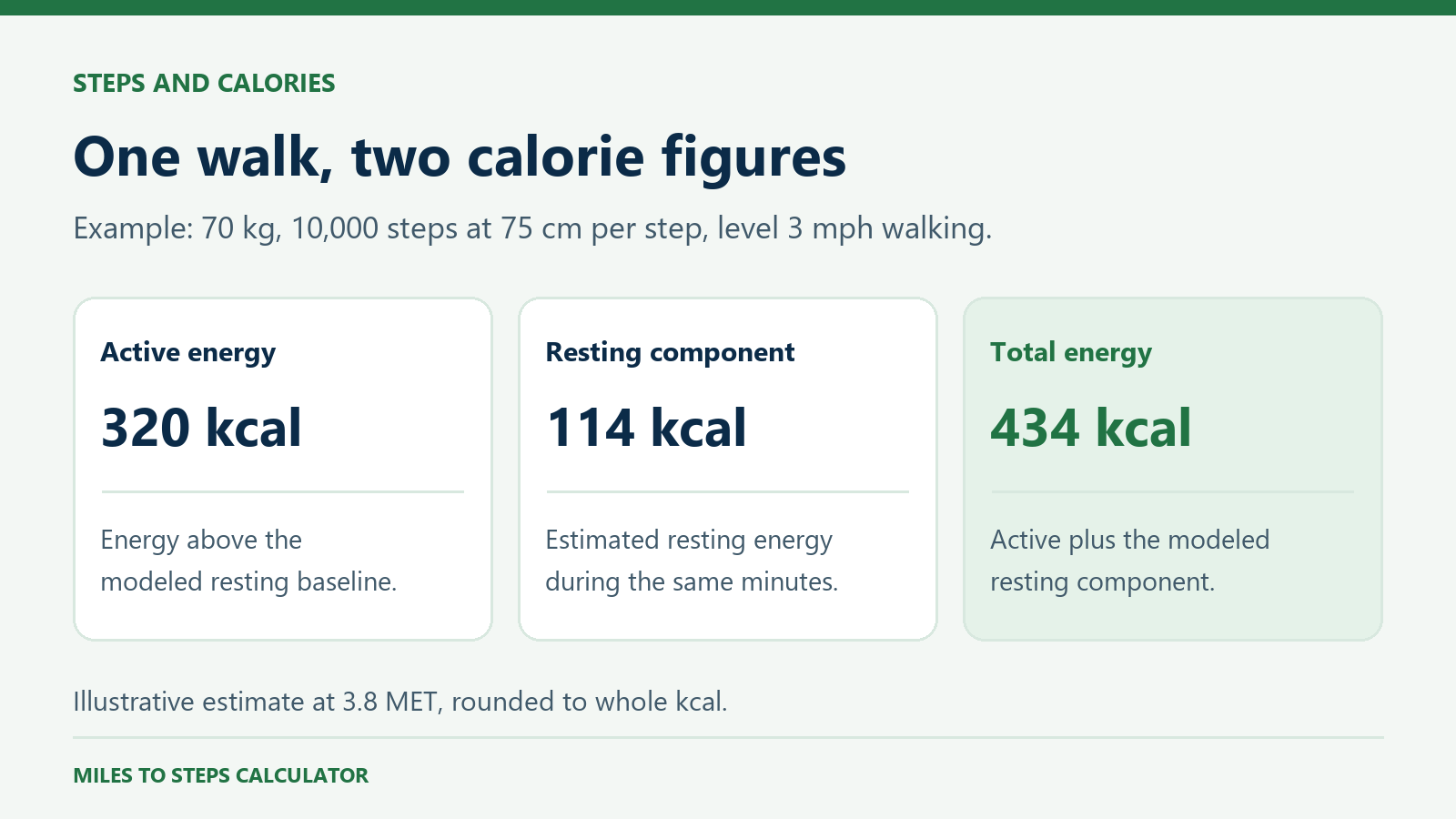
In one clearly specified example, a 70 kg person taking 10,000 steps at 75 cm per step covers 7.5 km. At a steady 3 mph on a level, firm surface, the estimated duration is about 93 minutes. Using a 3.8 MET activity value gives approximately 434 total calories or 320 active calories. Those are model estimates for that example, not a promise about your day.
Use the Steps to Calories Calculator to change the assumptions. In this guide, “calorie” means a dietary kilocalorie, written kcal. For the distance question itself, see How Many Miles Is 10,000 Steps?
10,000-step calorie examples by body weight
Every row below assumes 10,000 walking steps, a 75 cm step length, 3 mph (4.828032 km/h), no incline and continuous movement. The distance is 7.5 km, approximately 4.66 miles. We use 3.8 MET from the 2024 Adult Compendium walking category for level walking at 2.8–3.4 mph. This chosen step length is an example, not an average assigned to all adults.
| Body weight | Total (gross) kcal | Active (net) kcal |
|---|---|---|
| 55 kg / ~121 lb | 341 | 251 |
| 70 kg / ~154 lb | 434 | 320 |
| 85 kg / ~187 lb | 527 | 388 |
| 100 kg / ~220 lb | 620 | 457 |
The differences between rows come from body weight in the equation; the route and assumed intensity are unchanged. Pounds are approximate conversions of the kilogram weights. Values are rounded to whole kcal to make the table readable, not because the underlying estimate is accurate to one calorie.
These rows represent a hypothetical continuous walk. Ten thousand steps accumulated while shopping, cooking, commuting and walking outdoors do not necessarily have the same duration or intensity profile. Applying one walking MET value to an entire day’s steps can misrepresent that mix.
Calories for 1,000, 5,000, 15,000 and 20,000 steps
This comparison keeps the example person at 70 kg and retains the same 75 cm step length, level 3 mph speed and 3.8 MET value. Under those fixed assumptions, twice the steps means twice the moving time and estimated calories. The model does not assert that real-world step length or intensity stays unchanged during a much longer walk.
| Steps | Distance | Moving time | Total kcal | Active kcal |
|---|---|---|---|---|
| 1,000 | 0.75 km | 9 min | 43 | 32 |
| 5,000 | 3.75 km | 47 min | 217 | 160 |
| 10,000 | 7.5 km | 1 hr 33 min | 434 | 320 |
| 15,000 | 11.25 km | 2 hr 20 min | 651 | 480 |
| 20,000 | 15 km | 3 hr 6 min | 868 | 639 |
For example, 20,000 steps is 15 km under the chosen step length. It is a substantially longer outing than 10,000 steps, and fatigue or breaks can change the conditions. Treat the last row as a scaling example rather than a recommended daily target. The guide to daily step-count research addresses the separate question of whether everyone needs a particular goal.
How the estimate is calculated
- Distance: steps × step length. With length in centimetres, divide by 100,000 to obtain kilometres.
- Moving time: distance in kilometres ÷ walking speed in km/h × 60.
- Total energy: MET × 3.5 × body weight in kg ÷ 200 × moving minutes.
- Active energy: use MET − 1 in place of MET in the same equation.
MET is a standardized activity-intensity value. The equation converts an assumed oxygen cost to an approximate energy cost. The Compendium explains the standard MET definition; its methodological notes also explain why such values are not precise individual measurements.
For our 70 kg example, the gross rate is 3.8 × 3.5 × 70 ÷ 200 = 4.655 kcal per minute. Multiply that by the unrounded walking duration to obtain the total estimate. The active rate is (3.8 − 1) × 3.5 × 70 ÷ 200 = 3.43 kcal per minute.
Some simplified calculators use MET × kg × hours instead. That convention yields a slightly different result from the oxygen-based equation used here. Check methods before comparing two websites, and do not mix one site’s gross output with another site’s active output.
Active calories versus total calories
Total, or gross, exercise calories include the energy attributed to resting metabolism during those same minutes. Active, or net, exercise calories attempt to represent energy above that baseline. Our net estimate subtracts a standardized 1 MET; it does not measure your personal resting metabolic rate.
In the 70 kg example, the difference between the gross and active estimates is roughly 114 kcal over about 93 minutes. Both numbers can describe the same modeled walk. Choosing the larger number does not mean the person did extra exercise.
A watch may use different definitions, sensor inputs and resting-energy assumptions. Before deciding that its result disagrees with this table, check whether its label means active calories, workout total or total daily expenditure. Do not add a gross walking estimate on top of a daily total that already includes that walk and its resting energy.
What affects calories burned from steps?
Step length and distance
Ten thousand 65 cm steps cover 6.5 km; ten thousand 85 cm steps cover 8.5 km. That difference changes moving time at the same speed. Measuring your own step length makes the distance assumption more useful, although your length can change with speed or terrain.
Body weight
The equation scales with body weight when its other inputs stay fixed. A 20% higher weight produces a 20% higher modeled result. That mathematical relationship does not capture all differences in movement economy or body composition between individuals.
Speed and incline
Speed changes both the activity intensity and the time needed to cover a distance. Faster walking can raise energy per minute while reducing total minutes; these two effects should be considered together. Uphill walking needs a suitable incline method or activity category rather than a level-ground value. Use the Incline Walk Calorie Calculator for its stated treadmill conditions.
Mixed daily activity
Running steps, stair climbing and short household movements are different activities. A single level-walking estimate is not a complete model for every footfall. If you know the separate durations, estimating the bouts individually can be more informative than forcing all steps into one category.
How many steps would burn a given number of calories?
You can invert the same assumptions, provided you specify whether the target means gross or active calories. Divide your target by the modeled kcal per step. The per-step value is total estimated kcal ÷ the number of steps used to calculate it.
For the 70 kg, 75 cm, level 3 mph example, the model gives about 0.0434 gross kcal or 0.0320 active kcal per step. A 500 kcal target would therefore correspond to approximately 11,500 steps using gross calories, or 15,600 using active calories. These are rounded scenario calculations, not a prescribed exercise goal.
Do not interpret a calorie target as a requirement to compensate for food. This calculation does not predict weight change: food intake, other activity, resting metabolism and behavior over time also matter. Its useful role is comparing explicitly defined walking scenarios, not promising a particular result on the scale.
Make the inputs more representative
Use a recent body-weight entry if you choose to use weight in a calculator. Measure step length over a known route at the pace you intend to walk. Record moving minutes rather than assuming that an entire afternoon was continuous walking. Select the activity description that resembles the actual surface and pace.
Our calculator’s sensitivity band is an illustration of changing an estimate, not a validated confidence interval. An uncertain input can produce an uncertain result even when the arithmetic is correct. For comparisons over time, consistency in how you record the walk is often more useful than reporting additional decimal places.
Steps-and-calories questions
Does 10K steps mean the same thing as a 10K race?
No. Ten thousand steps is a footfall count. A 10K race is a fixed distance of ten kilometres. Your step length determines how far your steps carry you.
Can I use one fixed calories-per-step number?
Only as a shorthand for a specific set of assumptions. It changes when body weight, step length, activity intensity or duration changes.
Why does my tracker show fewer calories?
It may report active rather than gross calories, use different inputs, or identify a different activity pattern. Compare definitions and duration before comparing the totals.
Sources and limits
The activity values and methodological limitations are linked above. The 2024 Adult Compendium paper describes the research framework. Tables here are calculated scenarios, not measurements of study participants or a clinical assessment. Published November 7, 2026 by Miles to Steps Calculator. Site methodology · Corrections.